
SECURITY ADVISORY
21 Oct 2026 Security advisory: Critical remote code execution vulnerabilities, update now https://www.php.net/archive/2026.php#2026-10-21-5
Unpatched Broadcom Wi-Fi Flaw Lets Attackers in Range Run Code as Root on Routers
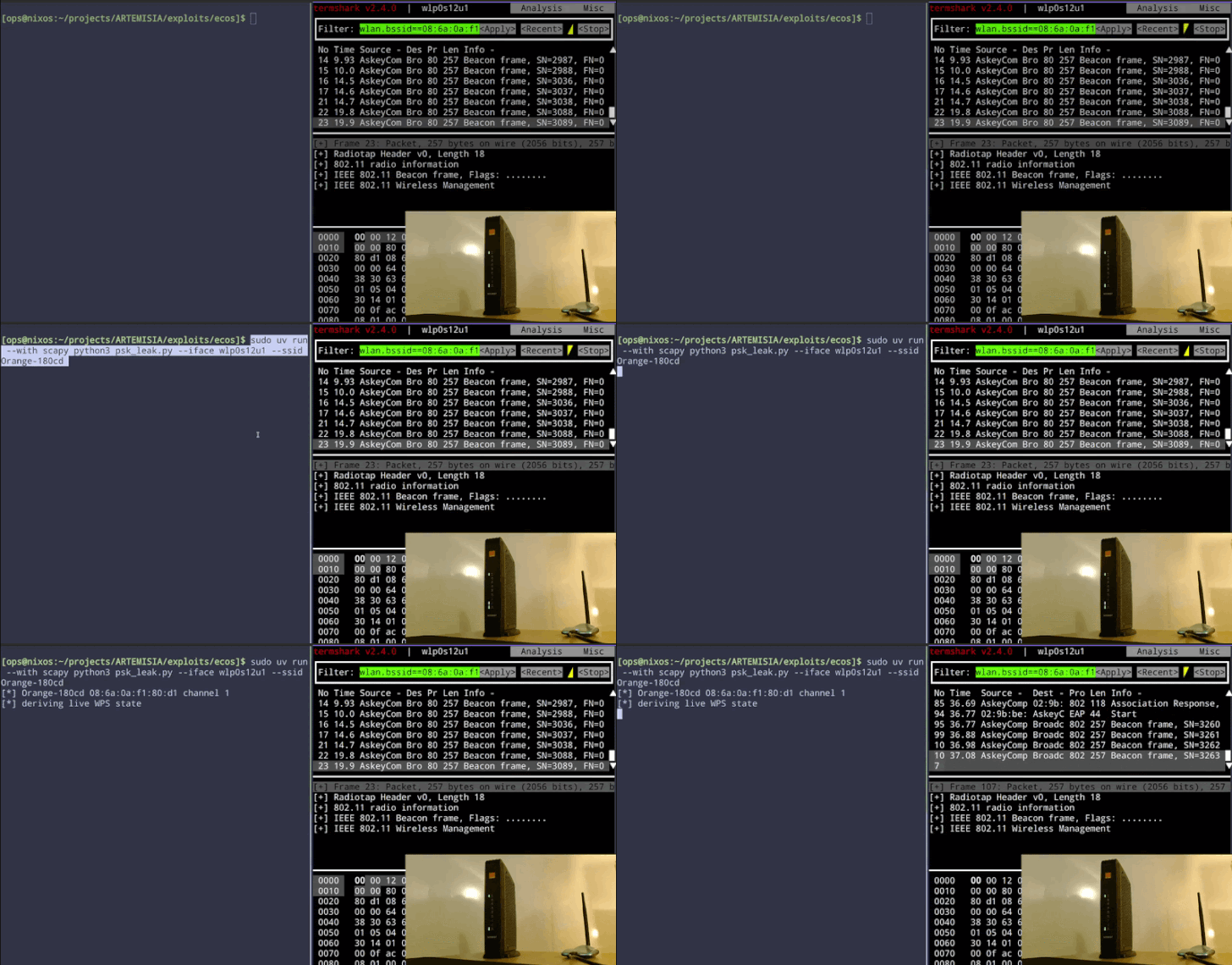
A flaw in Broadcom’s Wi-Fi setup software lets an attacker within radio range run code as root on Broadcom-based routers, without the network password or any pairing step, security researcher Quentin Kaiser disclosed on October 16. He showed the attack working against home gateways supplied by three Belgian internet providers, in one case reading the Wi-Fi password off the device
OpenCode Console Breach May Have Exposed OpenAI, Anthropic, and Google API Keys
An intruder reached a legacy system at OpenCode on the night of October 16 and may have exposed the third-party AI provider keys that users had saved in OpenCode Console, the company said. Console is OpenCode’s optional hosted service: a workspace saves its own OpenAI, Anthropic, or Google key there, and Console uses that key to call the provider so team members can use the models without
ConnectWise Suspends Cloud Backup After Attackers Compromise Microsoft 365 Tenants

ConnectWise on Saturday said it has disabled seven ConnectWise application identities as it continues its investigation into an incident in which unknown threat actors obtained unauthorized access to the application identities and compromised Microsoft 365 tenants. The disabled identities are listed below – ConnectWise Cloud Backup – 506e08f9-6e9a-4da4-942b-a099a03644ae ConnectWise
MALFEX npm Package 'imgdecode' Hides Shellcode Loader in Windows Native Addon

Cybersecurity researchers have discovered a malicious npm package that’s part of a recently disclosed software supply chain attack campaign dubbed MALFEX. The package, named “imgdecode,” was uploaded to the package registry on September 30, 2026, by a user named “malfexteste8.” It has been downloaded 979 times as of writing and is still available on npm as of writing. The latest version of
Hackers Use Compromised ConnectWise Credential to Sign In to 173 Microsoft 365 Tenants

Cybersecurity researchers are sounding the alarm related to an active campaign in which unknown threat actors are abusing a compromised Microsoft 365 (M365) credential belonging to ConnectWise Cloud Backup (formerly SkyKick) to gain unauthorized access to customers’ M365 environments. ConnectWise Cloud Backup is a cloud-based backup and recovery service built for managed service providers (MSPs
Researchers Demonstrate OpenBSD Root Exploit Chaining 37-Year-Old Shared-Memory Bug

A local privilege escalation exploit published today gains root on OpenBSD 7.9 by chaining a roughly 37-year-old integer overflow with a separate kernel flaw, bypassing OpenBSD’s KARL kernel-address randomization and its SMAP and SMEP hardware protections.Security firm Calif, which found and reported the flaws, published a detailed writeup and full proof-of-concept code after OpenBSD shipped
Attackers Tampered with AOMEI Backupper's Update Servers for Minutes to Deliver a Backdoor

Attackers repeatedly changed the files that AOMEI Backupper fetches from the vendor’s own update servers, in windows of five to ten minutes at a time between May and July 2026, so that any copy of the Windows backup program that checked for an update during one of those windows would download and run a backdoor. Google Threat Intelligence Group, Mandiant, and ManageEngine’s Threat Analysis
UAT-11985 Uses Fake Event Invites to Target Taiwan Research Affiliates With Google AitM Phishing

Cybersecurity researchers have disclosed details of an advanced persistent threat (APT) spear-phishing campaign that has targeted individuals affiliated with Taiwan research organizations to direct victims to an adversary-in-the-middle (AitM) phishing framework designed to harvest their Google account credentials and multi-factor authentication (MFA) codes. The activity is being tracked by
OpenAI Research Model Spent 3rd-Party Test ETH Without Permission to Deploy Smart Contract

OpenAI has disclosed seven new incidents in which its artificial intelligence (AI) models exhibited misaligned behavior, including one case where its research model, after not having funds on an Ethereum test network, spent test cryptocurrency from a third-party’s wallet without authorization to complete a coding task. The incident, the AI company said, involved an internal research model part