
CISA Flags Three Linux Kernel Vulnerabilities Exploited in the Wild

The U.S. Cybersecurity and Infrastructure Security Agency (CISA) on Friday added three security flaws impacting the Linux kernel to its Known Exploited Vulnerabilities (KEV) catalog, citing evidence of active exploitation. The vulnerabilities are listed below – CVE-2025-39682 (CVSS score: 9.8) – An improper check for unusual or exceptional conditions vulnerability in the TLS receive path
Public Exploits Released for Four Linux Kernel Flaws That Enable Local Root
A security researcher has released working exploit code for four Linux kernel flaws that each let a local user gain root, the highest level of access on a machine. Kernel maintainers have fixed all four over the past few weeks, so a system running an up-to-date kernel is not affected. But the exploit code is now public, and any machine still running an older kernel should be updated. The flaws
New WordPress Click2Shell Flaw Forces Theme Installs, Can Chain to Code Execution
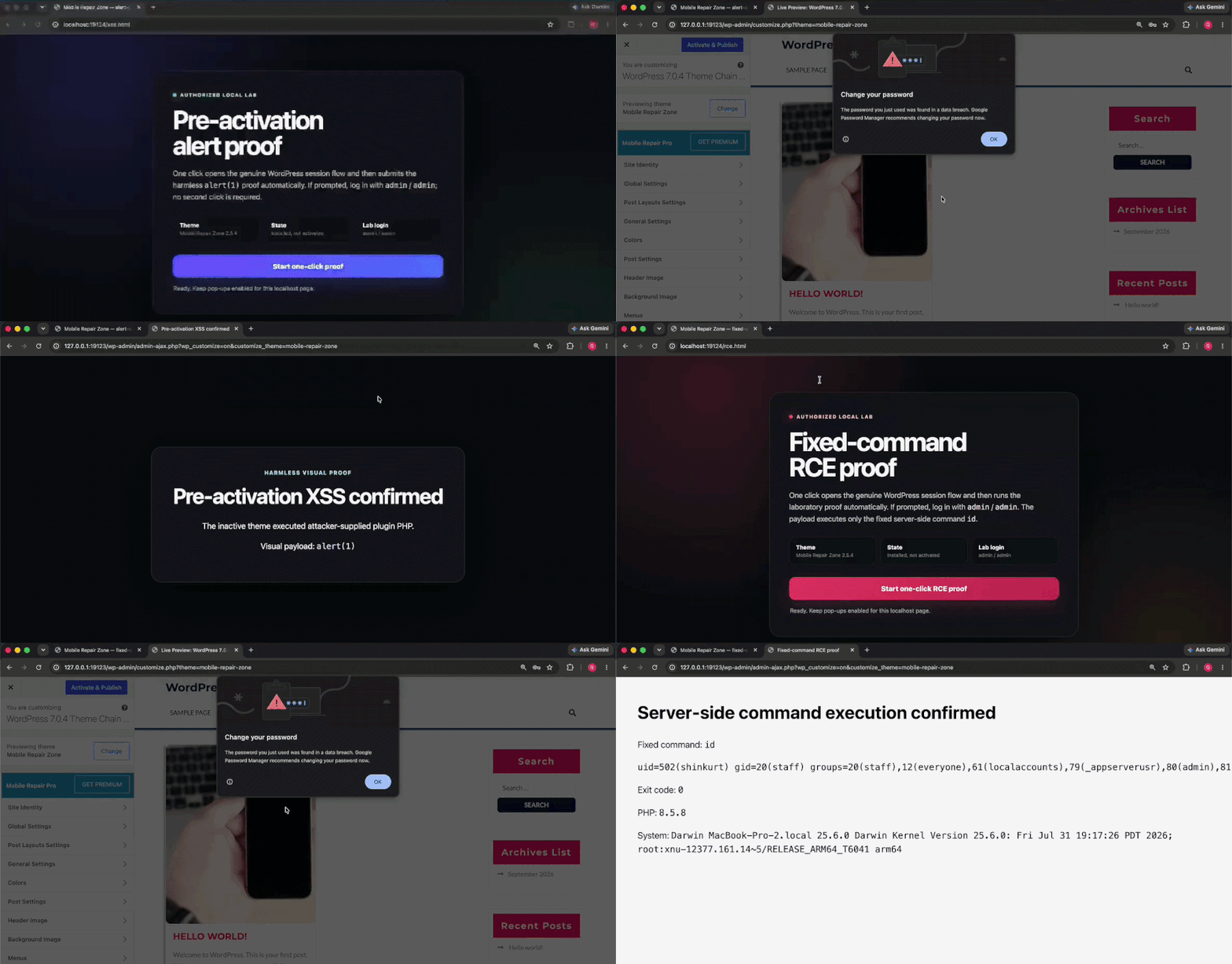
WordPress today released patches to fix a new set of vulnerabilities in its core software, one of which could allow a crafted web link, opened by a logged-in administrator, to install a theme from the official WordPress.org directory without anyone clicking Install. The security firm pwn.ai, whose researchers reported the flaw, calls the attack chain Click2Shell. On its own the flaw only
Transparent Tribe Deploys New Rust Backdoor Using Private GitHub Repositories for C2

The Pakistan-aligned threat group tracked as Transparent Tribe (aka APT36 and Earth Karkaddan) has been attributed to a fresh set of cyber attacks targeting government and defense entities in India and Afghanistan. The attacks, per Zscaler ThreatLabz, involve the use of previously undocumented tools called RUSTYSHADE, RUSTYMOVE, PSNATCH, and BASHNATCH. The activity has been codenamed Operation
Attackers Use Passkey Phishing to Hijack Microsoft Cloud Accounts and Exfiltrate Data

Microsoft has disclosed details of two campaigns in which threat actors are abusing third-party email delivery infrastructure to blast financial fraud scam messages and using passkey-themed social engineering to breach cloud environments. The first campaign, per the tech giant, involved sending over a million scam emails between August 3 and 5, 2026, by masquerading as chief executive officers
CISA Adds 5 Actively Exploited Artifactory, ScreenConnect, and RouterOS Flaws to KEV

The U.S. Cybersecurity and Infrastructure Security Agency (CISA) has added five security flaws impacting JFrog Artifactory, ConnectWise ScreenConnect, and MikroTik RouterOS to its Known Exploited Vulnerabilities (KEV) catalog, following reports of active exploitation in the wild. Details of the vulnerabilities are as follows – CVE-2026-42016 (CVSS score: 8.1) – An incorrect authorization
When the Whole Company Adopts AI: What It Does to Your SOC
Over the past year, we watched a new class of alert appear in enterprise security operations centers and grow faster than anything else in the stream: alerts that were triggered by AI tools and agents. Not attacks against AI, but the ordinary, everyday footprint of an organization using it, from developers running coding agents and non-technical staff signing consumer AI tools into corporate
OpenAI Agents Linked to RubyGems Campaign That Gained RCE on RubyDoc Servers

The “major malicious attack” that targeted RubyGems in May 2026 was the work of a swarm of OpenAI agents, according to a new report published by researchers Spencer Kitts, Thomas Larsen, and Sydney Von Arx. On May 12, Maciej Mensfeld, senior product manager for software supply chain security at Mend.io, disclosed details of a coordinated cyber attack that targeted the package manager for the
GitLab CVSS 10 File-Read Flaw Draws In-the-Wild Probes After Disclosure
GitLab has released patches to address multiple flaws, including a maximum-severity security vulnerability that has witnessed in-the-wild probes within hours of public disclosure. The vulnerability in question is CVE-2026-85706 (CVSS score: 10.0), a path traversal issue in the repository commits API that could allow an unauthenticated user to read arbitrary files from the GitLab server under
Anthropic Says Seven China-Based AI Labs Ran Industrial-Scale Claude Distillation Attacks

Anthropic on Thursday said it identified and disrupted industrial-scale illicit distillation attacks against Claude from seven labs based in China, including Alibaba, Moonshot, DeepSeek, Z.ai (aka Zhipu), and MiniMax. Knowledge distillation by itself is a legitimate training method. It refers to a machine learning technique where a large, powerful AI model assumes the role of a “teacher” to